
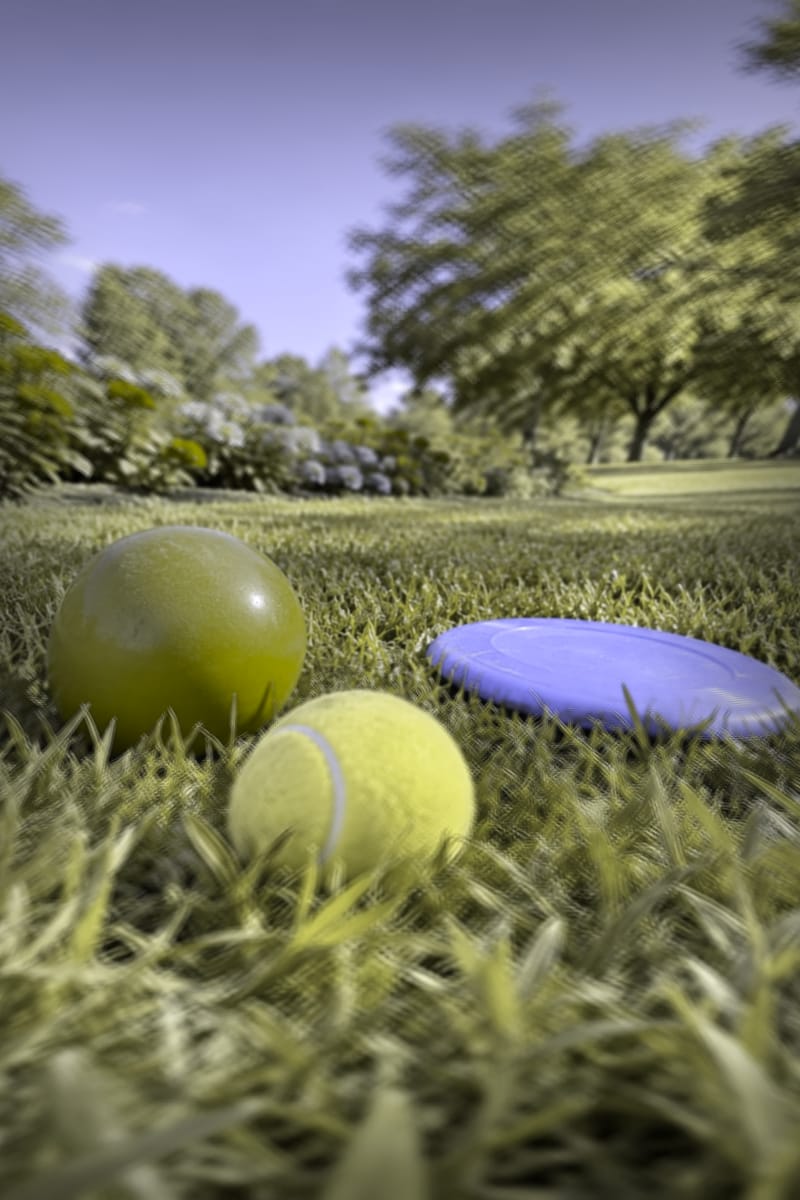


How the simulator works
Your eyes have three kinds of color cones. A dog's and a cat's have two: one most sensitive to blue-violet light and one to yellow-green. Light you see as red, orange or green all lands on the same long-wave cone, so those colors fold into one range of yellows and browns, while blue stays blue. Each lens applies that fold to every pixel, with the dichromat projection of Viénot, Brettel and Mollon that vision scientists use to simulate red-green color blindness, matched to the animal's cone types.
Color is only part of it. Each lens also draws what the eye does with space and light: a dog's horizontal band of sharp vision and wide field, a cat's brighter night view, a horse's near-panoramic field with a blind wedge under its nose. Those parts are exaggerated so they show on a small screen. The color shift is not.
The lenses here are the eight free lenses of the Animal Vision app, drawn by the same code the app runs on your phone's camera, not a web imitation of it. Snake and Mouse sense things a photo cannot hold (heat, ultraviolet), so those two lenses are labelled as simulated in the app.
What colors do dogs see?
Mostly blues and yellows. Dogs have two kinds of color cones, most sensitive near 429 nm (blue-violet) and 555 nm (yellow-green), where people have three. Red, orange and green all land on the same long-wave cone, so a red ball on green grass looks like a darker yellow on a lighter yellow, while a blue toy stands out. Dogs are not colorblind in the black-and-white sense: they see color, with fewer distinctions. That is why the Dog lens keeps blue and yellow and folds red and green together.
Do cats see color?
Yes, but like dogs they are dichromats: their two cone types peak near 450 nm and 555 nm, so reds and greens look alike and blues stay distinct. Cats have many more rods than we do and a reflective layer behind the retina, the tapetum lucidum, so they see in far less light. The Cat lens shows both: the same red-green fold as the dog, a cooler cast, and shadows opened up.
Is this dog vision simulator accurate?
The color is as close as published cone data allows: each lens folds colors with a projection built from that animal's cone types, the method used to simulate color blindness in people. Everything else, such as the blur outside the sharp band, the glow and the dark edges of the field of view, is turned up on purpose so it shows on a phone or laptop screen. No simulator can show what a dog experiences, because brains, motion sensitivity and individual eyes differ. Treat it as a well-founded illustration, not a measurement. It is the same lens code the Animal Vision app runs.
Is the TikTok dog vision filter accurate?
Many dog vision filters on TikTok and Instagram tint the whole picture yellow or drain some of the color out. That is not what a dog's eye does. A dog still sees color: red and green fold onto one yellow-brown axis while blue stays blue, so a red ball on grass nearly disappears and a blue one stands out. This filter uses the Animal Vision app's dichromat projection, built from dog cone data, plus a dog's wider field and softer focus. Those two are turned up so they show on a screen, which is what the Science + enhanced badge on the tool means.
Does my photo get uploaded?
No. Your photo is opened and drawn entirely in your browser, by a script on this page. It is never sent to a server, stored or shared. Once the page has finished loading, the simulator keeps working with your network switched off.
Can I see this live through my phone camera?
Yes. That is what the Animal Vision app does: point your camera at a room, a toy or your dog and switch between 30 animals live. It is free on the App Store and Google Play. The eight lenses on this page are free in the app for good, and Pro, a one-time purchase, unlocks the other 22 and removes ads.
Sources
- Neitz J, Geist T, Jacobs GH. Color vision in the dog. Visual Neuroscience, 1989.
- Jacobs GH. The distribution and nature of colour vision among the mammals. Biological Reviews, 1993.
- Viénot F, Brettel H, Mollon JD. Digital video colourmaps for checking the legibility of displays by dichromats. Color Research & Application, 1999.