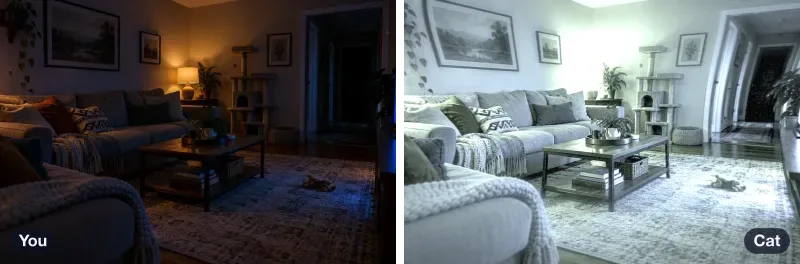
Animal Vision blog
Can deer see blaze orange?
Can deer see blaze orange? Yes, but not the way you do. A white-tailed deer has two color cones where you have three, so orange looks like a dull, muted tone to it instead of a loud signal. It still notices you through blue light, contrast and movement. Wear the orange anyway: it protects you from other hunters.
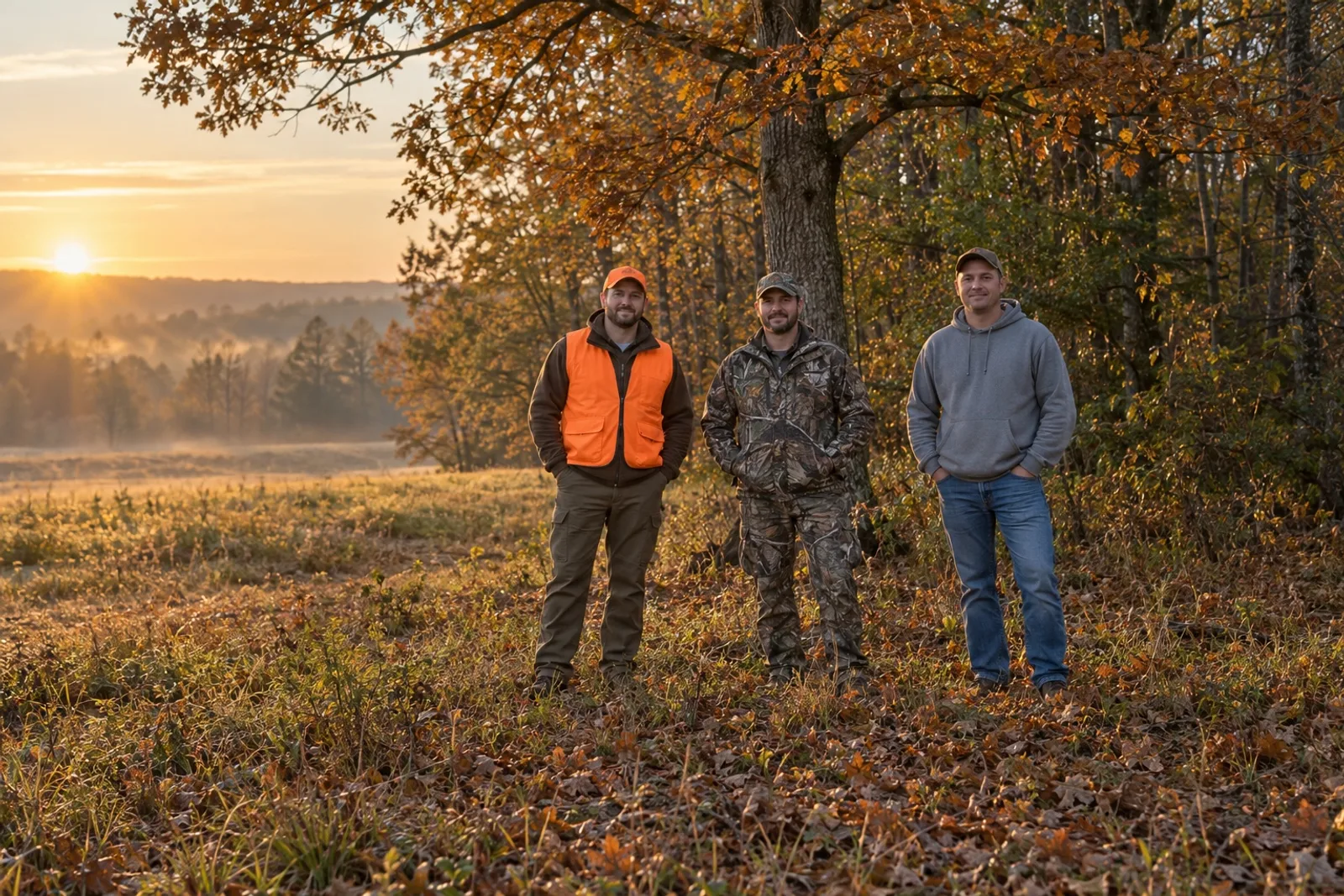
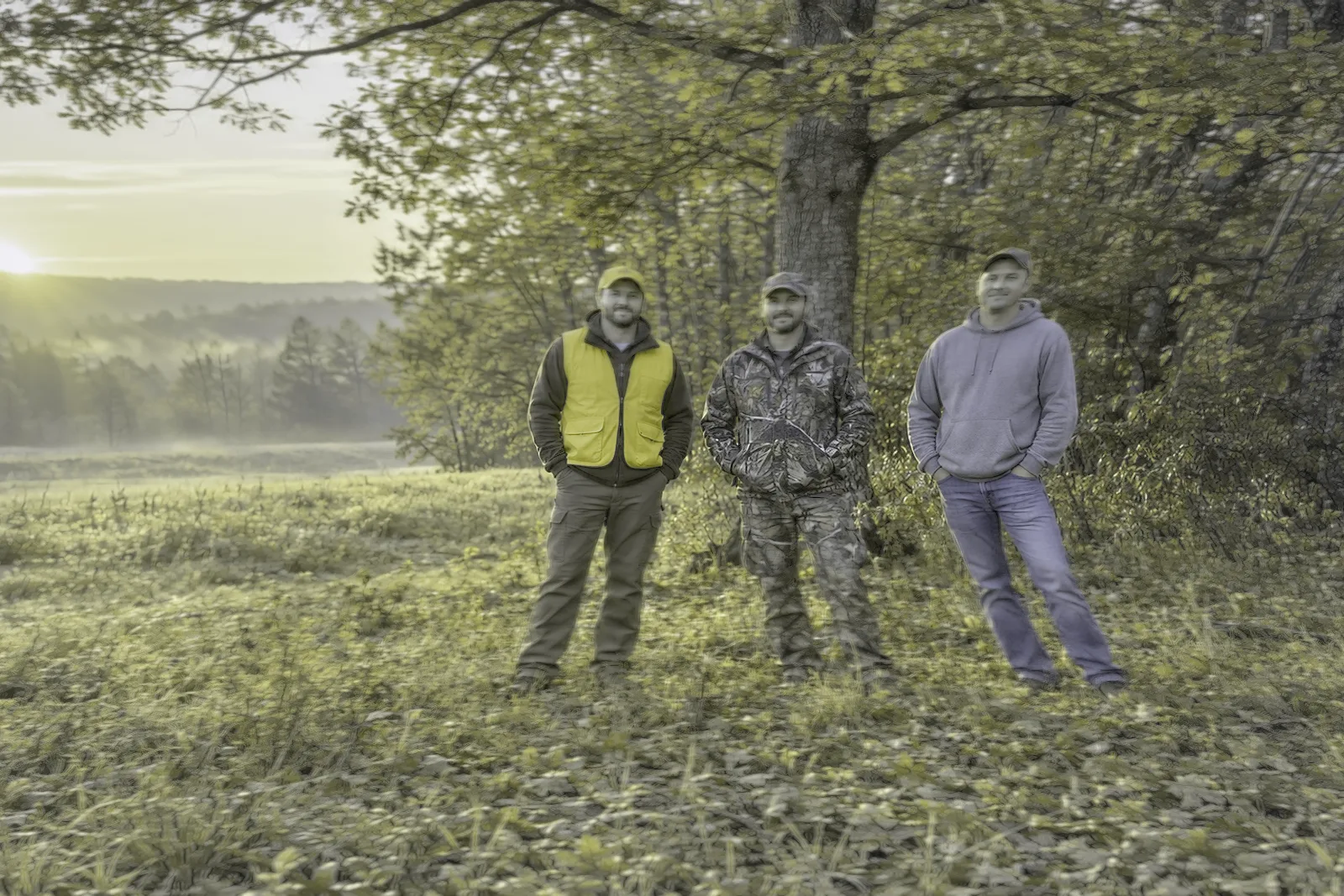
Almost everything solid about deer color vision comes from two studies tied to the University of Georgia. One is a 1994 paper that measured the cones in deer eyes. The other is a 2014 paper that tested what deer respond to. The rest of what you read in hunting magazines is inference, and some of it is lore.
What colors can deer see?
A 1994 study by Jacobs, Deegan, Neitz, Murphy, Miller and Marchinton, a team that included University of Georgia deer biologist Karl Miller, recorded the retina's electrical response in white-tailed and fallow deer. It found a rod pigment peaking near 497 nanometers and two cone types. One cone is most sensitive around 450 to 460 nanometers, which is blue. The other peaks near 537 nanometers in white-tailed deer (542 in fallow deer), in the green-yellow part of the spectrum. Humans have a third cone tuned to longer, redder light.
Two cones is roughly the layout of human red-green color blindness. Blues stay blue and separate from yellows and grays. Greens, yellows, oranges and reds slide onto one yellowish range and differ mostly in brightness.
In 2014, Bradley Cohen, Karl Miller and colleagues at Georgia's Warnell School tested seven deer. The deer learned to pick a lit LED from an unlit one, and the researchers dimmed each color until the deer could no longer tell. The thresholds matched the cone data: deer were more sensitive to short wavelengths, less sensitive to long ones, and showed some sensitivity to ultraviolet. That is a small sample, and "some" is the authors' own cautious word.
The Deer lens in the app shifts colors the way a two-cone retina would, so greens, yellows, oranges and reds slide together. A phone camera records almost no ultraviolet, so the lens cannot show that part.
Deer vision vs human vision
| You | White-tailed deer | |
|---|---|---|
| Color cones | 3 | 2 (blue peak 450 to 460 nm, middle peak near 537 nm) |
| Blue and near-UV | Lens filters most UV | More sensitive to short wavelengths, some UV response |
| Orange and red | Strong | Needed brighter lights to notice long wavelengths |
| Detail (acuity) | 20/20 | Rough estimates of 20/60 to 20/100 |
| Dim light | Good, no reflective layer | Large horizontal pupil, rod-rich retina, tapetum |
| Field of view | About 180 degrees ahead | Very wide panorama from side-set eyes |
Two rows are softer than they look. The acuity range is Karl Miller's rough estimate as reported by MeatEater. The UV row rests on one small behavioral study plus lens data from deer relatives: reindeer and pudú lenses pass roughly a quarter of the ultraviolet-A that reaches them (Douglas and Jeffery, 2014). The white-tailed deer's own lens was not in that survey.
For every animal side by side, see how 30 animals see the same photo. Horses are dichromats too, covered in how do horses see.
Can deer see blaze orange?
They can detect it, but color adds little to the signal. Orange lands on the long-wavelength side, where a deer's one middle cone responds weakly and no second cone exists to tell orange from yellow-green. In Cohen's tests deer needed brighter lights to notice long wavelengths than short ones. Dry grass and autumn leaves sit on that same yellowish side of the range, so against November woods an orange vest may not stand out much in color.
That is a reading of the cone data. I could not find a published test of how far away deer notice a hunter in blaze orange compared with camo. Karl Miller, who oversaw Cohen's work, says reducing movement matters more than color or camo pattern, according to MeatEater.
Wear it regardless. Blaze orange is there for the other hunters in the woods. In New York injury reports from 1989 to 1995, 117 of the 125 hunters who were shot after being mistaken for game (94 percent) had no hunter orange on, according to a CDC review. That is an association, not a controlled trial, but a strong one. Many states require orange during firearm deer season, and the minimum amount and the rules for patterned orange differ, so read your state's current regulations before opening day. If you worry about being seen, use cover to break up your outline and hold still. Do not take off the orange.
Blue jeans, khaki and laundry detergent
The lore says blue jeans and freshly washed clothes glow to deer. The reasoning has four links, and they are not equally strong.
First, deer are more sensitive to blue and some UV (measured, small study). Second, optical brighteners, which most laundry detergents and bleached cotton contain, absorb near-ultraviolet light and re-emit it as visible blue (well-established chemistry). Third, brightened cloth should therefore look bluer and brighter to a blue-sensitive animal, most of all at dawn and dusk when the light is rich in blue (plausible, untested). Fourth, that makes deer spot or spook at hunters more (untested).
I found no published test of that last link. The closest thing is a secondhand report in MeatEater that four of six camo shirts reflected enough blue light to stand out against a neutral background for captive Georgia deer. I could not find that test in a journal. Miller doubts that deer see UV as a glow like a blacklight; he says they simply see deeper into the blue. Some of the web articles on this topic come from, or quote, companies that sell UV-blocking laundry products.
Jeans get the blame because denim blue sits right where deer are most sensitive. Blue is also rare in November woods, so if anything stands out it could be that. Nobody has tested it. Khaki and other pale cotton are more likely carriers of brighteners than dark green camo, since brighteners are used to whiten cotton, and pale cloth reflects more light overall. Camo shirts are not exempt if that secondhand shirt report holds up.
If you want to hedge, washing hunting clothes in a brightener-free detergent costs almost nothing. A UV flashlight shows which garments glow. Neither replaces sitting still.
| Claim | How well supported |
|---|---|
| Deer have two cone types and no red-green discrimination | Measured (electrophysiology, 1994) |
| Deer are most sensitive to short wavelengths, least to long | Measured in behavior (7 deer, 2014) |
| Deer respond to some ultraviolet | Suggested by one small study and by lens data from deer relatives |
| Brighteners turn UV into blue light | Established chemistry |
| Brightened clothing makes hunters easier for deer to spot | Plausible, no published test found |
| Blue jeans are worse than other clothes | Untested |
| Blaze orange gives you away more than camo | No published test; Miller says movement matters more |
| Blaze orange protects you from other hunters | Strong association in injury data; required by many states |
Red vs green light at night
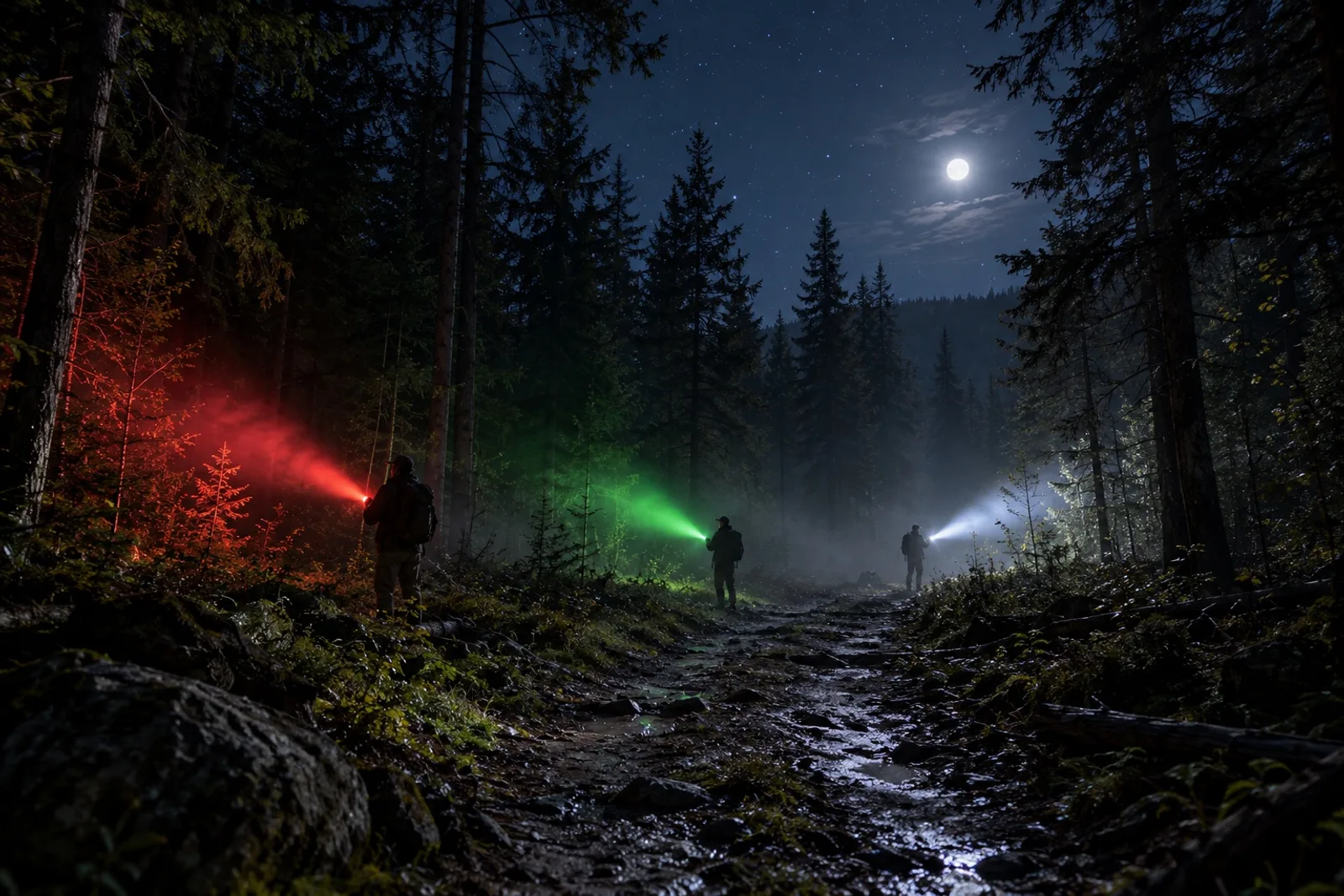
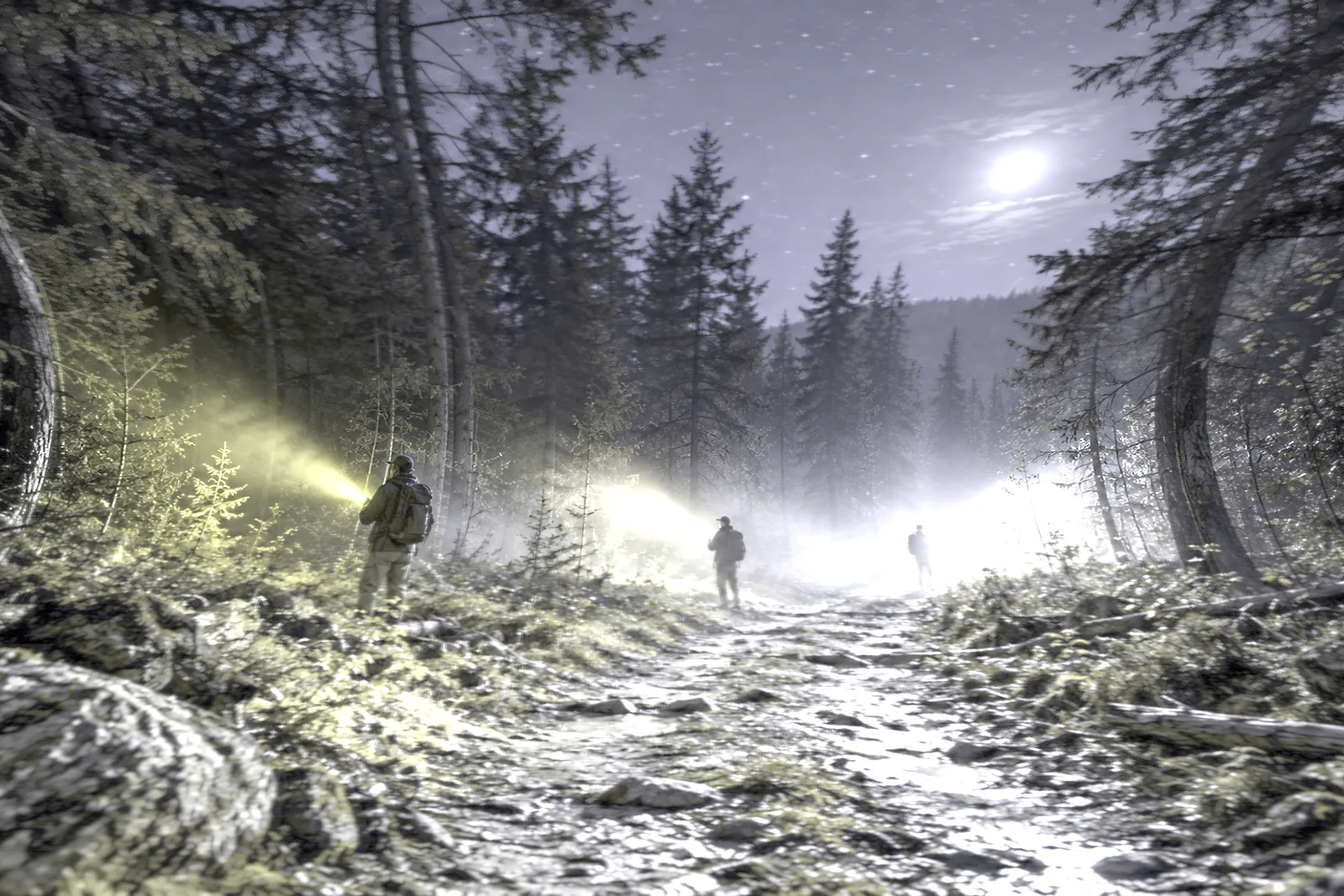
A deer's rods peak near 497 nanometers and its color cone near 537. A green light sits close to both peaks. A red light sits far down the long-wavelength slope. Cohen's 2014 thresholds say deer need more intensity to detect long wavelengths, so at equal brightness red should be the hardest of the three beams for a deer to notice, and green, blue and white easier.
That is inference from spectral sensitivity. I found no study that walked red, green and white flashlights toward wild deer. A very bright red light is still detectable, and a beam swinging through the trees, a snapped branch or a squeaking boot may spook a deer before color matters. Many states also restrict artificial light while hunting, so check yours.
- You
- Deer
How deer see at night, and why movement gives you away
Deer are most active at dawn and dusk, when sky light is rich in blue. Cohen's team described deer vision as specialized for that crepuscular pattern and for spotting predators along the horizon.
Deer have wide horizontal pupils, and horizontal pupils sharpen contours ahead and behind the animal, giving a panorama that helps detect predators and cross uneven ground (Banks and colleagues, 2015). Their retinas are rich in rods, and a reflective tapetum behind the retina gives light a second pass, which is the glow you see in headlights. Dogs and cats have one too.
Rods carry no color, so as light drops, color vision fades for deer and for you. In true darkness nothing sees. In moonlight a deer likely sees shapes and motion better than you do, and motion is the one thing you can control. Move slowly and as little as you can.
Try the free web simulator Open a photo and see it through the app's eight free lenses. The photo stays in your browser.You can test the orange-versus-denim question on your own photos. The Deer lens is one of eight free lenses in the free web simulator, and the Animal Vision app runs it live on your phone camera.
Frequently asked questions
Can deer see orange?
Deer can detect orange, but it looks muted to them. White-tailed deer have two color cones instead of three, so orange, red, yellow and green fall on one yellowish range that differs mostly in brightness. In lab tests deer needed brighter lights to notice long wavelengths than short ones. Wear blaze orange anyway, because it protects you from other hunters.
Do deer see blue jeans and ultraviolet light?
Deer are more sensitive to blue than people are, and a 2014 University of Georgia study found some sensitivity to ultraviolet light. Whether jeans or detergent-brightened clothes make deer spot hunters more often has not been tested in any published study I could find. Holding still probably matters more than fabric.
Can deer see red light?
Poorly, compared with blue or green. A deer's rods peak near 497 nanometers and its color cone near 537, so red light sits far from both. A bright red light can still be detected, and no published field test shows how wild deer react to different headlamp colors. Movement and noise likely matter more than the color of the beam.
Can deer see at night?
Yes, much better than people in dim light, but not in total darkness. Deer have large horizontal pupils, a retina rich in rods and a reflective layer behind it called the tapetum. Rods carry no color, so color vision fades as light drops. At night deer lean on movement, smell and hearing as well as sight.
Do I still have to wear blaze orange?
Check your state's rules, because many states require hunter orange during firearm deer season and the minimum amount varies. Even where it is optional, wear it. In a CDC review of New York hunting injuries from 1989 to 1995, 117 of 125 hunters who were mistaken for game were not wearing hunter orange.
Sources
- Jacobs, Deegan, Neitz, Murphy, Miller & Marchinton (1994). Electrophysiological measurements of spectral mechanisms in the retinas of two cervids: white-tailed deer and fallow deer. Journal of Comparative Physiology A 174:551-557
- Cohen, Osborn, Gallagher, Warren & Miller (2014). Behavioral measure of the light-adapted visual sensitivity of white-tailed deer. Wildlife Society Bulletin 38:480-485
- Douglas & Jeffery (2014). The spectral transmission of ocular media suggests ultraviolet sensitivity is widespread among mammals. Proceedings of the Royal Society B 281:20132995
- Banks, Sprague, Schmoll, Parnell & Love (2015). Why do animal eyes have pupils of different shapes? Science Advances 1:e1500391
- Salas, Gutierrez-Bouzan, Lopez-Grimau & Vilaseca (2019). Respirometric study of optical brighteners in textile wastewater. Materials 12:785
- CDC (1996). Hunting-associated injuries and wearing hunter orange clothing, New York, 1989-1995. MMWR
- Durkin (2018). Deer vision: how whitetails see color, light and movement. MeatEater (interviews with Bradley Cohen and Karl Miller of the University of Georgia)