Animal Vision blog
Can dogs see in the dark (and can cats)?
Can dogs see in the dark? In dim light, yes, and cats do it even better. Both have a mirror-like layer behind the retina, the tapetum lucidum, that people lack. In total darkness, no eye can see, because there is no light to catch. A cat needs up to seven times less light than you do.
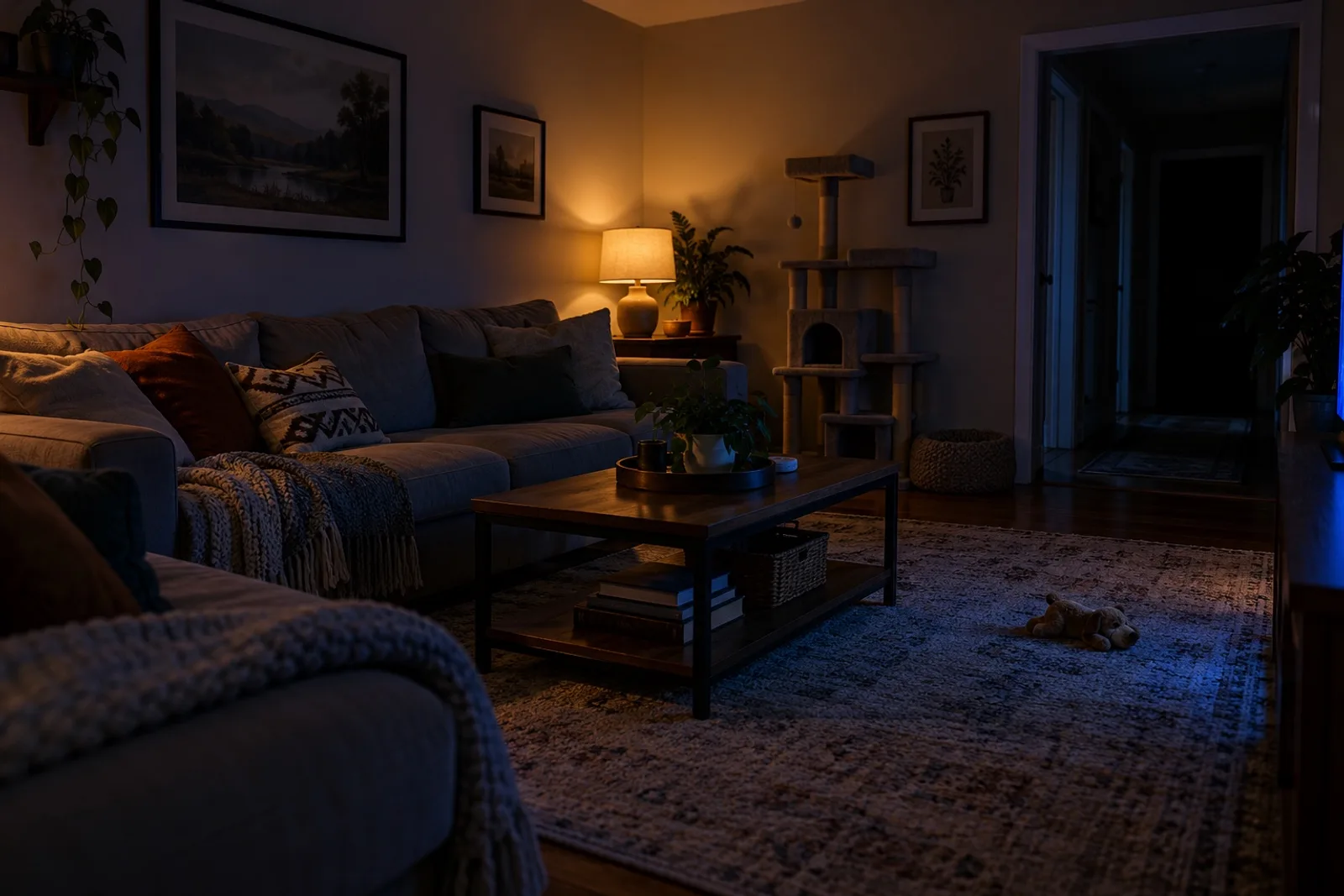
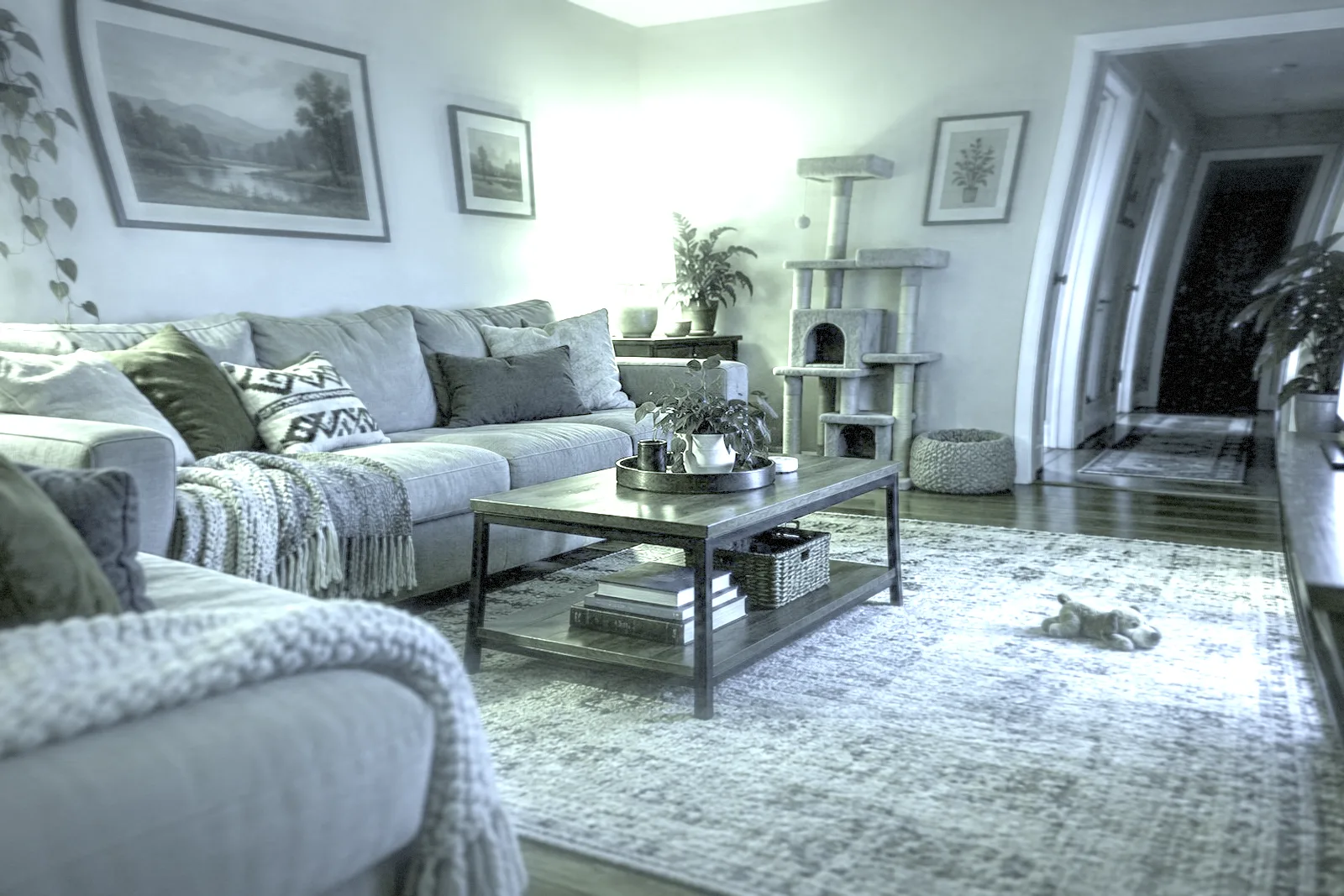
Why can dogs and cats see better than humans in the dark?
Start with the retina. Veterinary ophthalmologist Paul Miller lists a retina dominated by rods, the photoreceptors that respond to very little light, among the cat's night adaptations. He says dogs share many of them to a lesser degree. Cones, which handle color and fine detail, are the minority.
Behind the retina sits the tapetum lucidum, a layer of reflective cells. Light that passes through the retina without being absorbed bounces off it and crosses the photoreceptors a second time. A 2004 review by Ollivier and colleagues at the University of Florida found that every type of tapetum works this way, which raises sensitivity at low light levels. People, like other primates, have none. The same mirror makes a cat's eyes glow in a flashlight beam: you are seeing light the retina missed.
Then there is the pupil. A 2015 paper in Science Advances by Martin Banks and colleagues at UC Berkeley and Durham University reports that a cat's slit pupil changes its area about 135-fold between bright and dark, against about 15-fold for a human's round pupil. A cat's eye can close down in sunshine and open wide at night.
Dogs have the same equipment on a smaller scale. Miller's 2001 review notes that the canine tapetum reflects less light than the feline one.
Can cats see in the dark better than dogs (or humans)?
Cats can. Miller reports that a cat's minimum light threshold is up to seven times lower than a human's. A 2009 experiment at the University of Illinois (Kang and colleagues) ran parallel dim-light experiments with cats and people and found cats about 5.5 times more sensitive to large, blurry targets, a gap of 0.74 log units. Most of that edge came from the cat's optics gathering more light, not from better wiring.
For dogs, veterinary reviews say the threshold is not as low as a cat's but still well beyond ours. I could not find a reliable multiple for dogs, so I will not quote one.
A lower threshold is not a sharper picture. In the Illinois test the cat's advantage covered only coarse patterns. People were more sensitive to finer ones, and neither species could resolve fine patterns well in the dark. In a 2017 study by Lind and colleagues at Lund and Linköping universities, dogs in dim light resolved 1.8 to 3.5 cycles per degree. People managed 5.9 to 9.9, so a person could tell the same pattern from about three times farther away.
| Dog | Cat | Human | |
|---|---|---|---|
| Reflective tapetum | Yes, less efficient than a cat's | Yes | No |
| Light needed to see | Less than a human, more than a cat | Up to 7 times less than a human | Baseline |
| Pupil | Round | Vertical slit, about 135-fold area change | Round, about 15-fold area change |
| Detail in bright light | About 20/75 in older estimates; 5.5 to 19.5 cycles per degree in 2017 | 20/100 to 20/200 in classic estimates | 20/20; 32 to 44 cycles per degree in 2017 |
| Color cones | Two (blue and yellow) | Two (blue and yellow-green) | Three |
| Field of view | About 240 degrees | About 200 degrees | About 180 degrees |
Can dogs and cats see in pitch black?
No. An eye can only use light that arrives, and the tapetum recycles light that is already there. Sharon Crowell-Davis, a veterinary behaviorist at the University of Georgia, said in 2006 that cats see really well in dim light but "can't see in total darkness".
Total darkness is rare. A charger LED, a gap in the curtains or a half moon gives an eye with a mirror behind the retina something to work with. Where there is truly none, as in a closed windowless closet, a dog or cat moves by memory and smell. That is how a cat can know a room by heart and still bump into the chair you moved.
- You
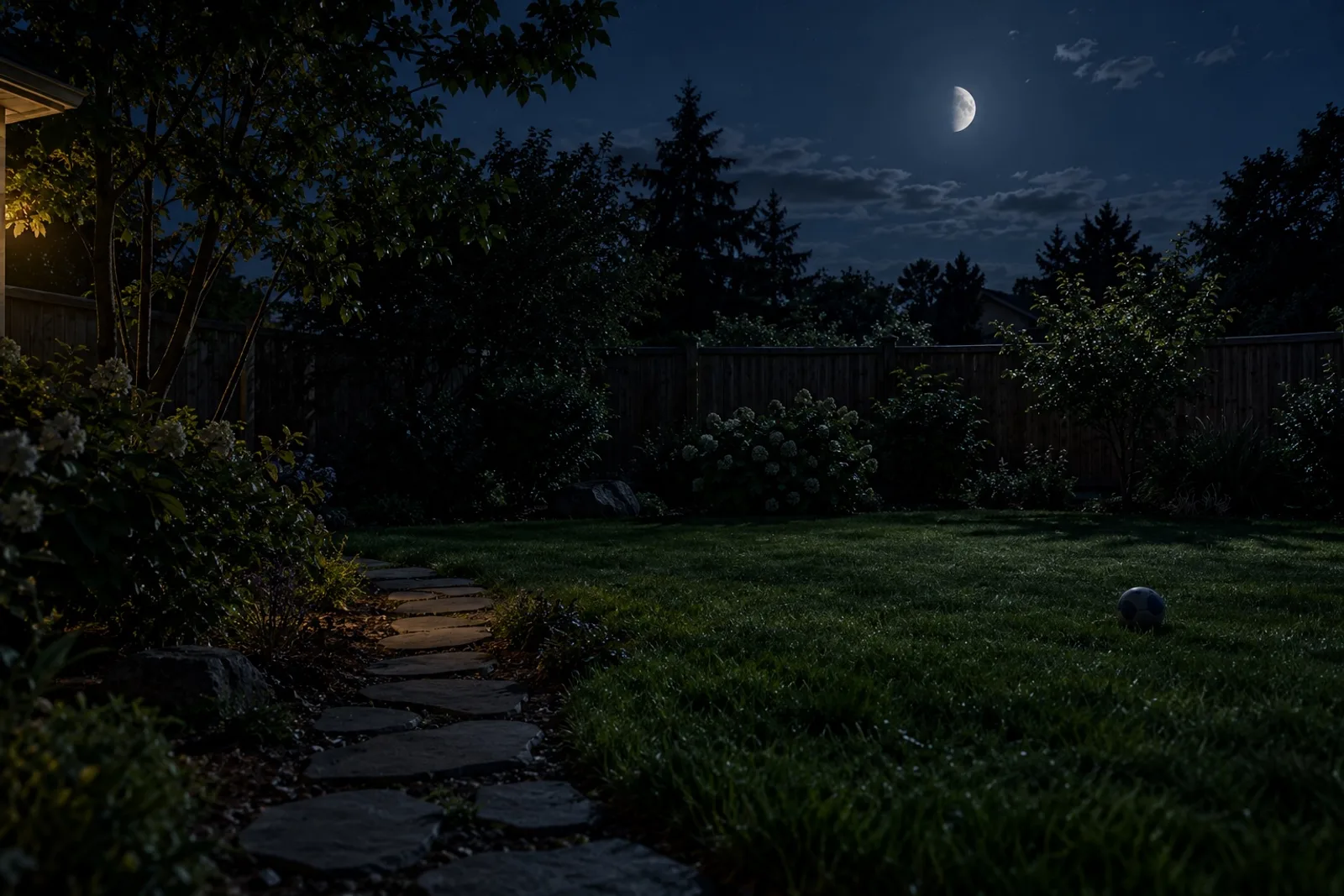
- Dog
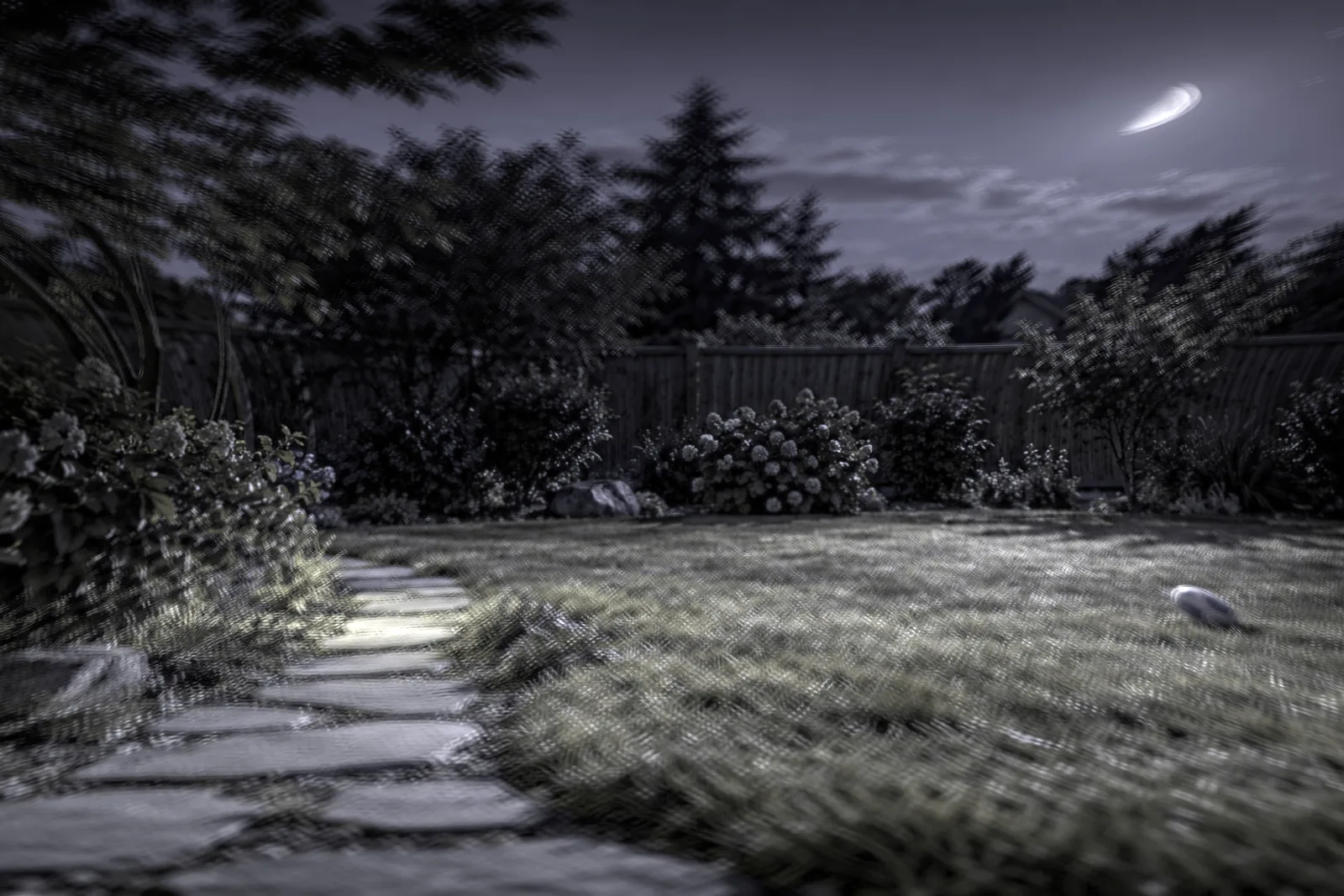
Should I leave a light on for my cat or dog?
A healthy adult cat or dog does not need one. A lamp does nothing for night vision, because they use whatever light is already in the room.
An older pet can be a different case. If a senior cat starts bumping into furniture, hesitating on stairs or going to the toilet outside the box at night, a dim night-light along its route can help. Cats Protection lists bumping into things, especially moved furniture, and eyes that look enlarged, cloudy or a different color as signs of sight loss. The PDSA adds uneven or very wide pupils and trouble in low light. Any of these is a reason to call your vet.
Can cats see the litter box in the dark?
In a dim room, yes. In total darkness, no. Crowell-Davis has seen cats that used the litter box by day and went elsewhere at night. In one case the box sat in a basement closet that the cat could only reach by dark stairs, and a night-light fixed it. Keep the box where it always is, since Cats Protection advises against moving litter trays for a cat with sight problems, and light the darkest stretch of the route.
What about dogs?
Dogs have the same adaptations as cats to a lesser degree, so a healthy dog gets around a dark house fine. An older dog that hesitates on stairs or at the back door at night may do better with a night-light there. I found no study that tests night-lights for dogs, so this is common sense, not a finding.
Evening walks after the clocks change
Daylight saving time ends on Sunday, November 1, 2026, in most of the US, and the clocks go back at 2 a.m. The walk you used to take at dusk now happens in the dark.
- You
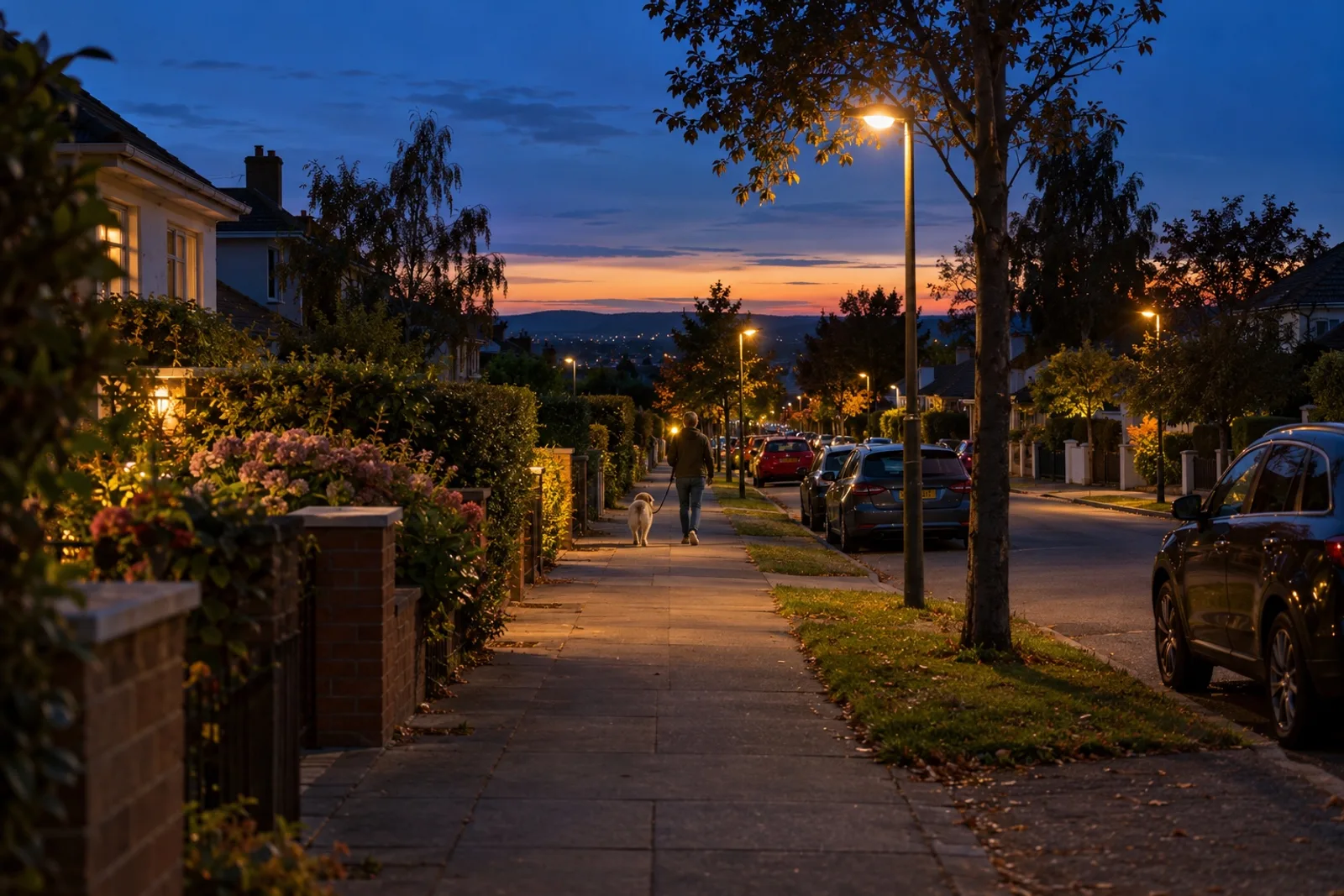
- Dog
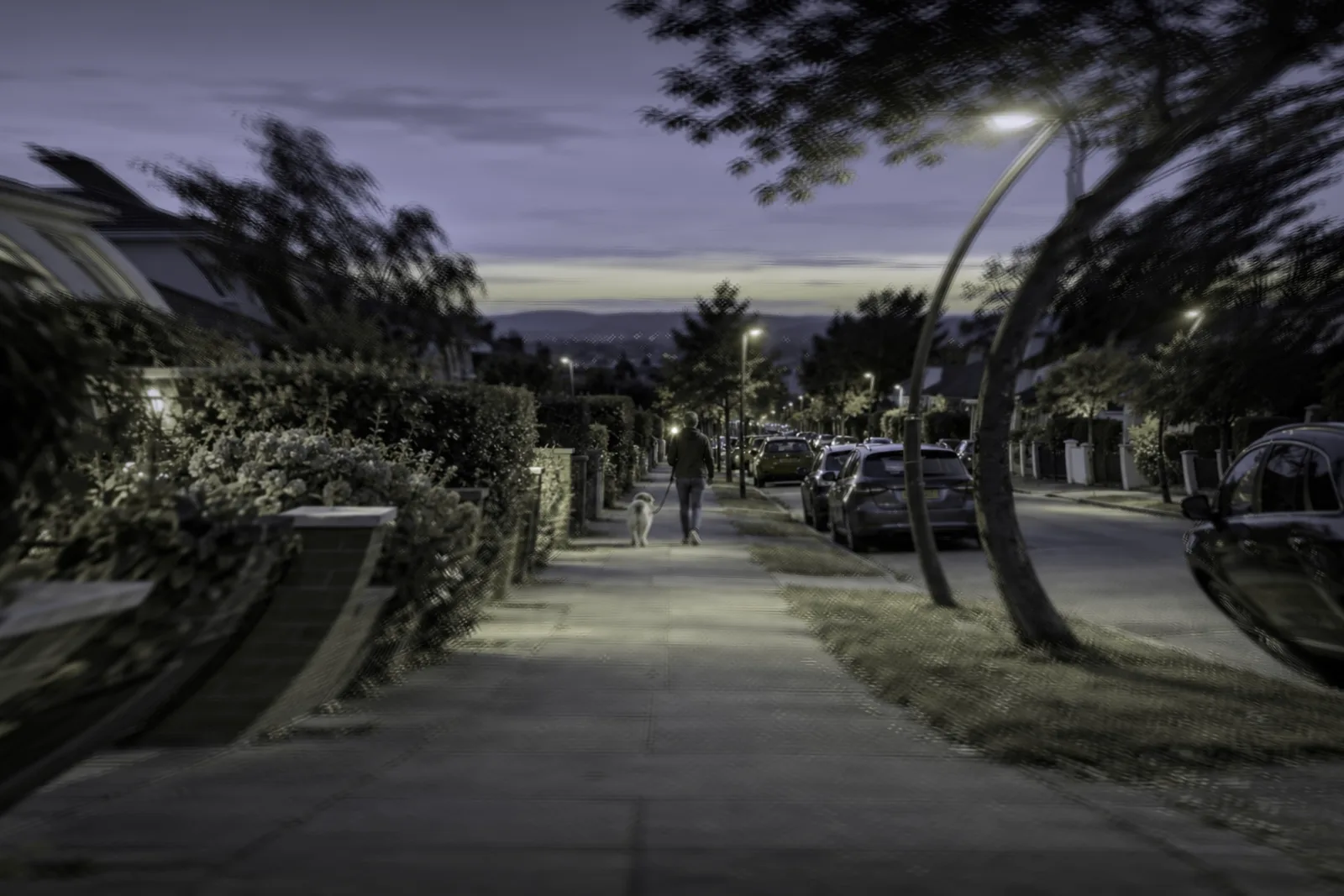
- Cat
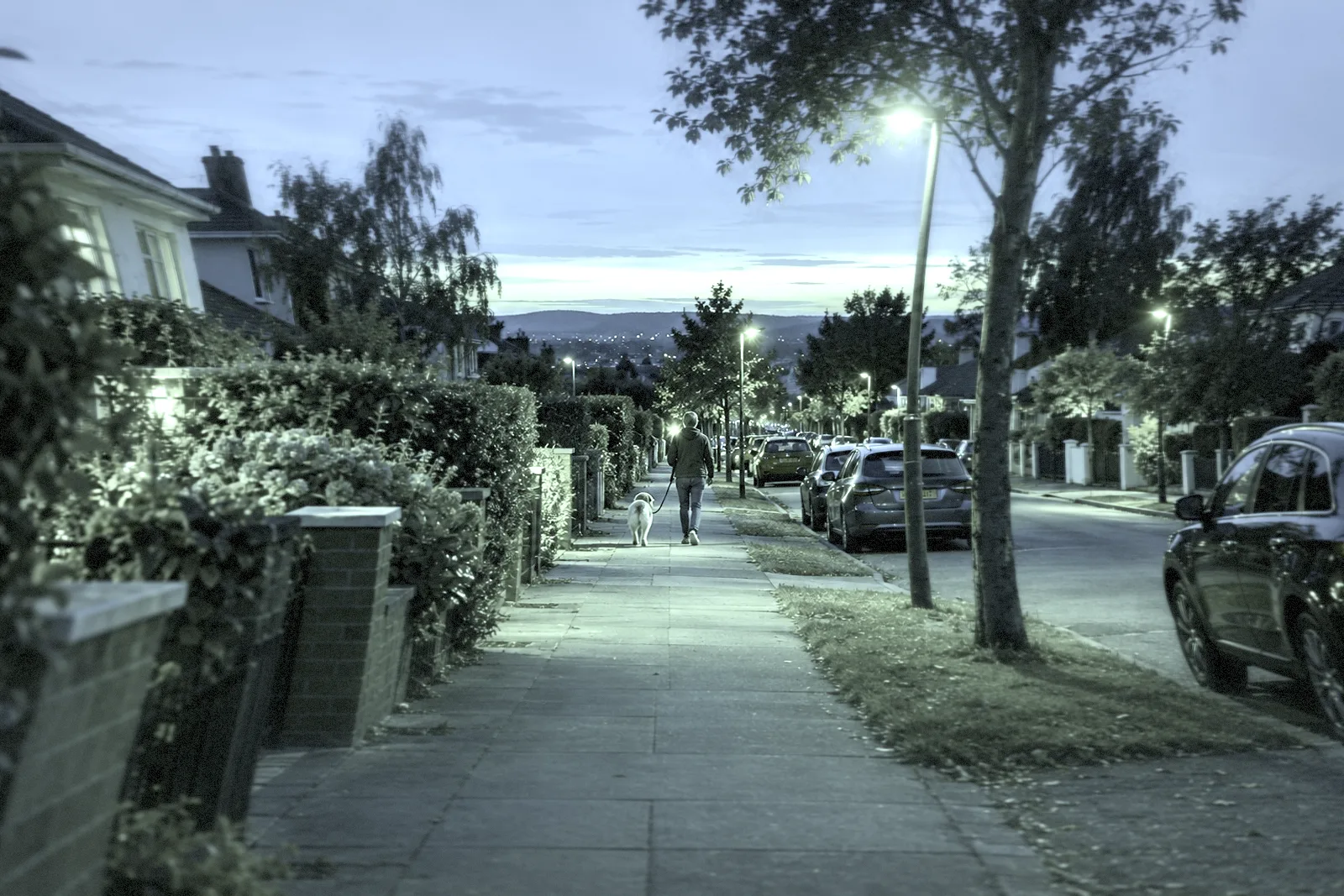
Your dog may cope with dusk better than you do. A dog may notice a moving squirrel or cat at the edge of its view before you do, and Miller notes that most dogs and cats ignore still objects there but reflexively chase them once they move. Keep the leash short near roads until your own eyes catch up.
The bigger risk is that drivers do not see the dog. The American Kennel Club advises a leash with reflective material if you walk near a road at night, and warns that thin retractable cords are hard to see in the dark. A reflective leash or a clip-on light costs little.
Colors at dusk follow the same dichromat rules as in daylight. For those, see what colors dogs can see and how cats see.
The Dog and Cat lenses in Animal Vision are free. The color shift follows the cone data for each animal (two cones, with peaks near 429 and 555 nm in the dog, per Neitz and colleagues), while the night brightening is turned up so it shows on a phone screen. Treat the brightness in these pictures as exaggerated. You can also run your own photos through the free web simulator.
Frequently asked questions
Can dogs see in the dark?
Dogs see better than people in dim light, but not in total darkness. They have a retina rich in rods and a tapetum lucidum, a reflective layer that gives their photoreceptors a second chance to catch light. Their night vision is less extreme than a cat's, and they still need some light, such as moonlight or a distant streetlamp.
Can cats see in the dark better than dogs?
Yes. Veterinary ophthalmologist Paul Miller reports that a cat's minimum light threshold is up to seven times lower than a human's, and that dogs have the same adaptations to a lesser degree. A cat's tapetum reflects light more efficiently than a dog's, and its slit pupil opens much wider in the dark.
Can cats see in pitch black?
No. In total darkness there is no light to catch, so no cat, dog or human can see. The tapetum only bounces back light that is already there. A room that looks pitch black to you often still holds a little light, and a cat can use it. A closed closet is different.
Should I leave a light on for my cat?
A healthy cat does not need one. If an older cat starts bumping into furniture, hesitating on stairs or missing the litter box at night, a dim night-light along its route can help. Those signs can also mean vision loss, so ask your vet to check its eyes.
Sources
- Ollivier et al. (2004). Comparative morphology of the tapetum lucidum (among selected species). Veterinary Ophthalmology 7(1)
- Miller, P. E. (2001). Vision in animals: what do dogs and cats see? Waltham/OSU Symposium, Small Animal Ophthalmology (VIN)
- Miller & Murphy (1995). Vision in dogs. Journal of the American Veterinary Medical Association 207(12)
- Kang et al. (2009). Contrast sensitivity of cats and humans in scotopic and mesopic conditions. Journal of Neurophysiology 102(2)
- Lind et al. (2017). High visual acuity revealed in dogs. PLOS ONE 12(12)
- Banks et al. (2015). Why do animal eyes have pupils of different shapes? Science Advances 1(7)
- Neitz, Geist & Jacobs (1989). Color vision in the dog. Visual Neuroscience 3(2)
- Clark & Clark (2016). Neutral point testing of color vision in the domestic cat. Experimental Eye Research 153
- Crowell-Davis, S. (2006). Quoted in News-Democrat. UGA Today, University of Georgia College of Veterinary Medicine
- Cats Protection. Blind cats (signs of sight loss and how to help)
- PDSA. Blindness in cats
- American Kennel Club. Dog leashes 101
- The Old Farmer's Almanac. Daylight saving time ends 2026