Animal Vision blog
What colors can dogs see?
What colors can dogs see? Blue, yellow and shades of gray. Their eyes have two kinds of color-sensing cones where ours have three, so red, orange and green all land on one dull yellow-brown band. Dogs are not black-and-white viewers. Their color vision is close to that of a person with red-green color blindness.
Are dogs color blind?
Partly, and the label misleads. "Color blind" sounds like seeing no color at all, but people with red-green color blindness see most colors fine. Dogs are dichromats: they have two cone types (the cells that sense color) where people have three. A dog's world is built from blue, yellow and gray. Red and green are missing as separate hues.
Yes or no?
No for black and white, yes for red versus green. A dog can tell a blue toy from a yellow one without trouble. It struggles to tell a red toy from a green one when both are about equally bright.
How do we know?
Three studies, each using a different method, point the same way.
In 1989, Jay Neitz, Tim Geist and Gerald Jacobs at the University of California, Santa Barbara, tested three dogs on behavioral color tasks. The results pointed to two cone pigments, peaking near 429 nm (violet-blue) and 555 nm (yellow-green), and to dichromatic color vision.
In 2013, Kasparson, Badridze and Maximov gave eight untrained dogs a choice between stimuli that differed in both brightness and color. The dogs went by color, not brightness.
In 2017, a team at the University of Bari in Italy built a dog version of the Ishihara test, the plate people use to screen for red-green color blindness. They showed 16 dogs animated cats made from the colored dots of one plate. The dogs reacted to the cat that red-green color-blind people can see and mostly ignored the one they cannot. That is the pattern seen in people with deuteranopia, a form of red-green color blindness.
Are dogs color blind to red and green?
Yes. A dog's long-wave cone peaks at 555 nm, and it responds all the way from yellow-green into red. But one cone type cannot tell those wavelengths apart, so it only reports how bright they are. According to veterinary ophthalmologist Paul Miller, wavelengths from about 500 to 620 nm are probably all seen as yellow. Red is just a dim yellow in that picture, and a dim, dark yellow is what most of us would call brown.
Some lists say dogs see "blue, yellow, gray and brown." Gray and brown are not extra colors. They are where the colors dogs cannot separate end up.
Do dogs see in black and white?
No. The belief is old and sticky. The American Kennel Club traces it to dog writer Will Judy's 1937 training manual, which described a world of black and gray. Early lab studies that concluded color cues did not matter to dogs kept it alive. Jacobs's 1993 review of mammal color vision describes the long-held view that few mammals have color vision at all, then argues the opposite: the baseline for mammals is dichromacy.
Dogs do use brightness. In one test they told shades of gray apart about half as well as people do (Pretterer and colleagues, 2004). But when a stimulus offers both color and brightness, as in the 2013 study above, color usually wins.
What colors can dogs see, one by one?
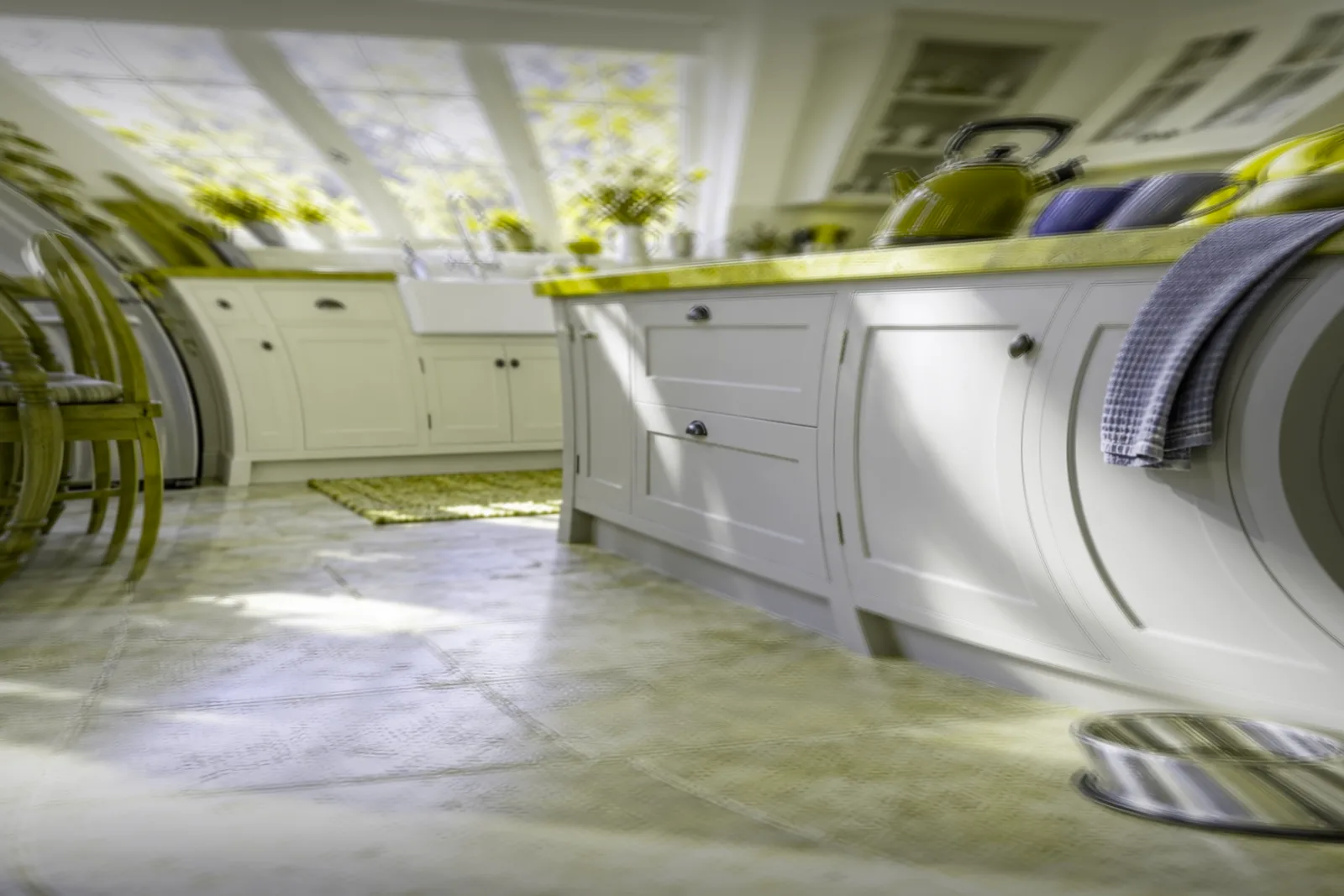
Each color's probable look follows from the cone data and Miller's wavelength ranges.
- You

- Dog
Can dogs see red?
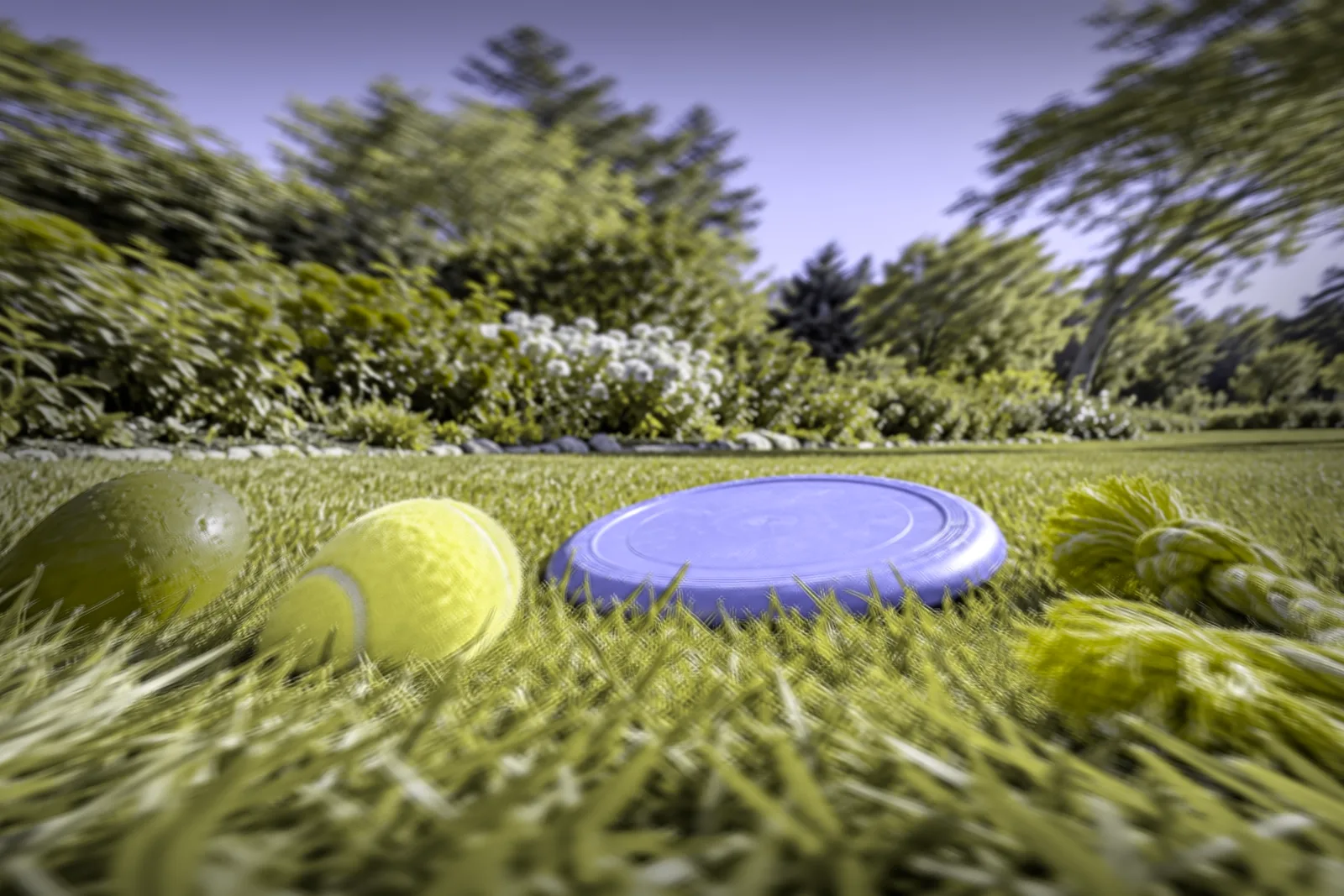
Not as red. A red ball looks like a dark yellow-brown. Grass turns a yellowish olive, so on a lawn the red toy has almost the same color as its background and stands out only by a small difference in brightness.
Can dogs see orange?
As a yellowish shade. Orange sits inside the 500 to 620 nm band that dogs probably see as yellow, so an orange rope toy looks like a darker, duller yellow. Against grass it works mostly through brightness, which makes it easier to find than red but harder than yellow or blue.
Can dogs see green?
Not as green. Grass and green balls turn into a yellowish olive. A green ball on a lawn is a camouflage problem. Blue-green near 480 nm is the one spot where a dog's two cones balance out, and Miller puts the dog's gray point there. A toy in that turquoise shade may look gray.
Can dogs see yellow?
Yes, and clearly. The long-wave cone peaks at 555 nm, in the yellow-green zone. In a 2025 study of 134 free-ranging dogs in India, the dogs preferred a yellow object over a blue or gray one. When a yellow object was set against a gray one with food, they went for the yellow first.
Can dogs see blue?
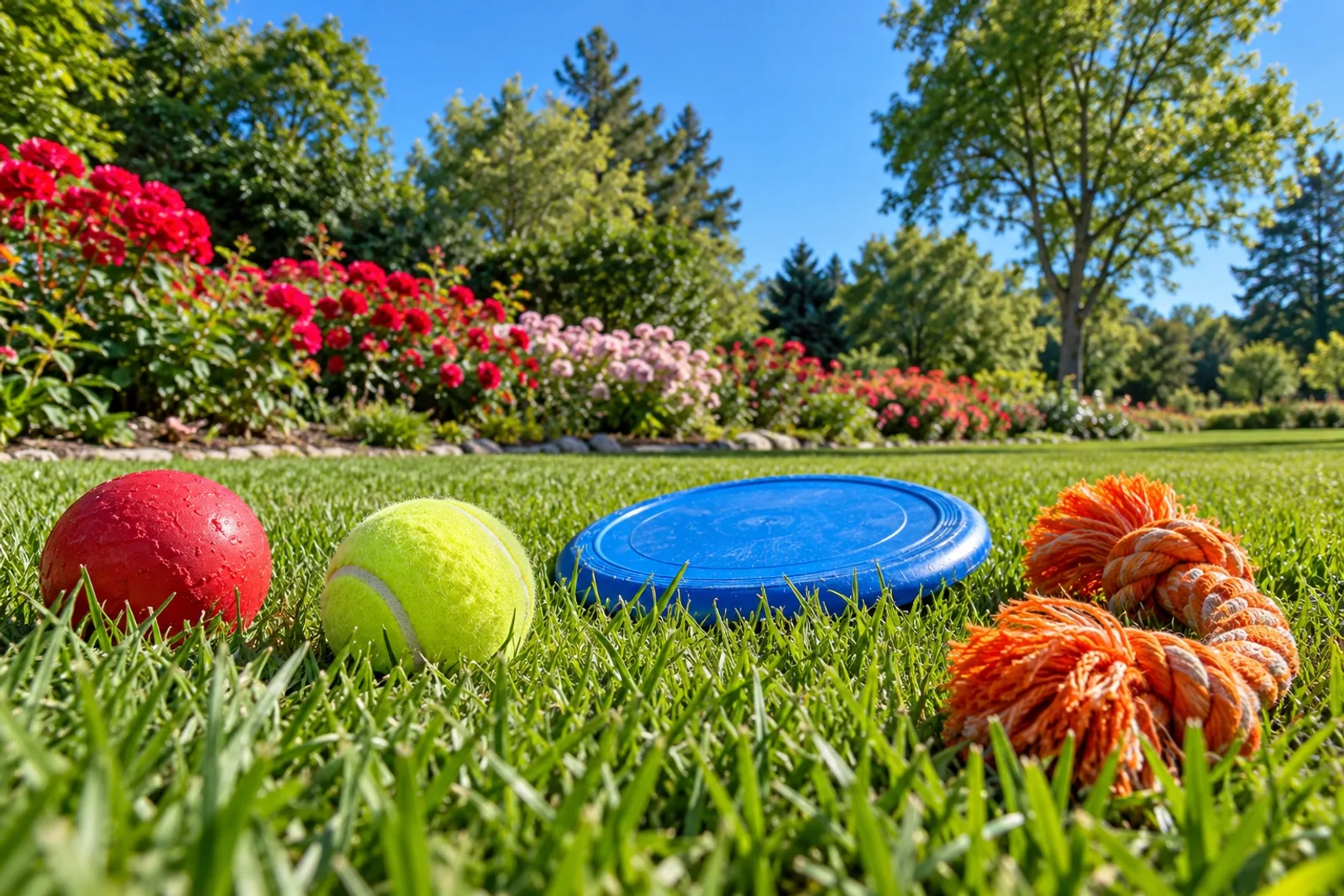
Yes. Violet and blue (about 430 to 475 nm) are probably seen as blue. Purple turns into a deeper blue, and the blue frisbee in the lawn photo keeps its color while everything around it goes olive. Pink loses its hue and drifts toward gray.
 You
Dog
A Christmas tree is a good test. The red and green bulbs your dog walks past look like pale yellow bulbs of different brightness. Only blue bulbs would keep a trace of their color, and on a busy tree even they are easy to miss.
Dog vision vs human vision
Color is one difference among several.
| Human | Dog | |
|---|---|---|
| Cone types | 3 (blue, green, red) | 2 (blue, yellow-green) |
| Cone peaks | About 420, 534 and 563 nm | About 429 and 555 nm |
| Hues seen | Blue, green, yellow, red and everything between | Blue, yellow and gray; blue-green near 480 nm looks gray |
| Sharpness | 20/20; 32 to 44 cycles per degree in one 2017 test | About 20/75; 5.5 to 19.5 cycles per degree in the same test |
| Field of view | About 180 to 200 degrees | About 240 degrees, depending on breed |
| Overlap of both eyes | About 140 degrees | About 30 to 60 degrees |
| Flicker detection | About 50 to 60 Hz | About 70 to 80 Hz |
| Dim light | Weaker | Better, helped by a reflective layer behind the retina (the tapetum) |
Sharpness is the second big gap after color. In the 2017 test, people picked out fine stripes from roughly three times the distance dogs could. Dog vision is softer than ours, with color that has lost its red-green axis. How a dog sees you is a different question with its own answers, covered in how do dogs see humans. Night vision gets its own post too: can dogs see in the dark.
Faster flicker detection has a practical side. Miller notes that a TV refreshing 60 times a second can look like it is flickering to a dog. Dogs also see more of the sides of the world at once, at the cost of less overlap in front.
For toy shopping, the color results turn into a simple rule: blue and yellow beat red, orange and green. Our guide to the best toy colors for dogs shows it on grass, carpet and floors.
Try it: a science-fair test
Students ask this question every year. A fair test has to rule out three things that fool you: smell, brightness and you. The protocol below is our own simplified design, adapted from the two-choice, food-reward setups used in published dog studies. It is not a published protocol, and one dog cannot speak for all dogs.
- Hypothesis: the dog can tell blue from yellow but not red from green.
- Materials: identical plastic cups or flat cards in blue, yellow, red and green; gray cards in several brightness levels; treats; a helper; a phone to film the trials.
- Smell: put a treat under every cup, or hide one behind every card, so the dog cannot sniff out the right choice. Reward only the correct pick, by hand.
- Brightness: photograph your cards and switch the photo to black and white. If two cards look the same gray, brightness cannot give the answer away. For red versus green, use several shades of green and swap them at random, so a lighter or darker card is never the clue. In one study dogs told grays apart about half as well as people do, so make the shades clearly different.
- You: the owner looks at the floor and a helper who knows the answer sets the cards out of the dog's sight. Flip a coin for which side holds the correct card.
- Test A, blue versus yellow: first let the dog learn that blue earns the treat (blue against a gray card), then run 20 trials of blue against yellow.
- Test B, red versus green: teach red the same way, then run 20 trials of red against green, changing the green shade each time.
- Score: chance is 10 correct out of 20. Fifteen or more is unlikely to be luck (about 2 in 100). If the dog scores high on Test A and near 10 on Test B, that matches red-green color blindness.
Before you start, upload a photo of your cards to the free web simulator. Photos stay in your browser. If two cards turn into the same color in the Dog lens, that pair is the hard one.
Try the free web simulator Open a photo and see it through the app's eight free lenses. The photo stays in your browser.Point the app's camera at a toy, a lawn or your Christmas tree, and the Dog lens shows a live simulation. The colors follow the cone data. Blur and field of view are exaggerated so they read on a phone screen, and nothing here shows exactly what a dog sees.
Frequently asked questions
Are dogs color blind?
Not in the way most people mean it. Dogs are dichromats: they have two types of color-sensing cones where people have three, so they see blue and yellow well but cannot separate red from green. Their color vision is close to red-green color blindness in people. Dogs do not see the world in black and white.
What colors can dogs see best?
Blue and yellow. A dog's two cone types peak near 429 nm (violet-blue) and 555 nm (yellow-green), so blues and yellows look the most vivid and the most different from each other. Red, orange and green shift toward one dull yellow-brown, and blue-green near 480 nm looks gray. That is why blue and yellow toys are the safest picks.
Can dogs see red, green or orange?
Not as separate colors. Red, orange and green all fall in the stretch of the spectrum, roughly 500 to 620 nm, that dogs probably see as shades of yellow. The exact shade depends on how bright the object is. A red ball on green grass can look like a brownish ball on olive grass, with only a small difference in brightness to give it away.
Do dogs see in black and white?
No. Dogs see blue, yellow and gray. The black-and-white idea comes from early training manuals and old lab studies that treated color as unimportant to dogs. Modern tests show dogs use color, and in one study they picked color over brightness when both were on offer.
Do dogs see things we can't?
Possibly a little ultraviolet, and certainly faster flicker. Dog lenses let through a good amount of UVA light, which suggests some UV sensitivity, though no behavior test has confirmed it. Dogs also detect flicker at roughly 70 to 80 flashes per second, against 50 to 60 for people. Nothing suggests they see infrared with their eyes.
Sources
- Neitz, Geist & Jacobs (1989). Color vision in the dog. Visual Neuroscience 3(2)
- Kasparson, Badridze & Maximov (2013). Colour cues proved to be more informative for dogs than brightness. Proceedings of the Royal Society B 280
- Siniscalchi, d'Ingeo, Fornelli & Quaranta (2017). Are dogs red-green colour blind? Royal Society Open Science 4
- Jacobs (1993). The distribution and nature of colour vision among the mammals. Biological Reviews 68(3)
- Miller (2001). Vision in Animals: What Do Dogs and Cats See? Waltham/OSU Symposium, Small Animal Ophthalmology (VIN)
- Miller & Murphy (1995). Vision in dogs. Journal of the American Veterinary Medical Association 207(12)
- Cook (2008). How Well Does Fido See? Cataract & Refractive Surgery Today, July 2008
- Lind, Milton, Andersson, Jensen & Roth (2017). High visual acuity revealed in dogs. PLOS ONE 12(12)
- Bowmaker & Dartnall (1980). Visual pigments of rods and cones in a human retina. Journal of Physiology 298
- Pretterer, Bubna-Littitz, Windischbauer, Gabler & Griebel (2004). Brightness discrimination in the dog. Journal of Vision 4(3)
- Douglas & Jeffery (2014). The spectral transmission of ocular media suggests ultraviolet sensitivity is widespread among mammals. Proceedings of the Royal Society B 281
- Roy et al. (2025). Ready, set, yellow! Color preference of Indian free-ranging dogs. Animal Cognition 28
- American Kennel Club. Are dogs color blind?